


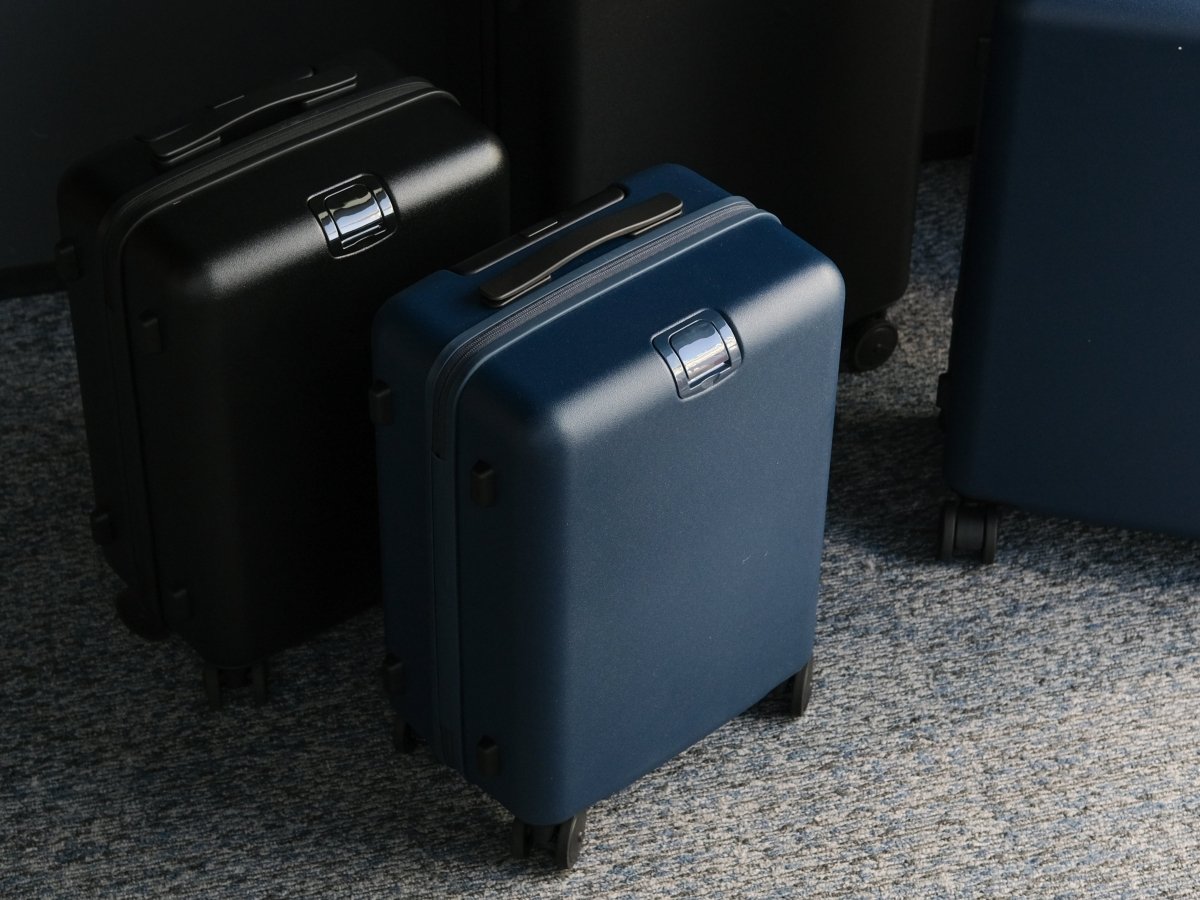
Differences in suitcase body materials
Suitcases are a purchase made only once every few years. That's precisely why we'll tell you what you should know when choosing one. This article explains the characteristics of six different suitcase body materials: hard-sided (ABS resin, polycarbonate, polypropylene, aluminum) and soft-sided (polyester, nylon).
At the end, we've included a little information about the suitcases sold at aucentic, so if you're interested, please take a look.

Which suitcase material is best?
First, for those short on time, here's a quick reference table of six key indicators for choosing a suitcase. The body material is a crucial factor that affects the durability, weight, and price of a suitcase. In this blog, we will delve into the details of each of these important body materials.

Hard-sided ①: ABS Resin

(Source: https://www.rakuten.co.jp/)
ABS resin is an abbreviation for acrylonitrile, butadiene, and styrene, a mix of three types of materials. It is widely used in other industries, but for hard-sided suitcases, it is one of the materials frequently used for affordable suitcases due to its low manufacturing cost.
In fact, LEGO blocks are also made of ABS resin, so anyone who has stepped on a LEGO block will have experienced its hardness firsthand.
The advantage of ABS resin is its high density, which makes the surface resistant to scratches. However, compared to materials like polycarbonate (which will be introduced later), it lacks flexibility, so it may be susceptible to damage from strong impacts. It is also slightly heavier. The price usually ranges around 10,000 yen.
Hard-sided ②: Polycarbonate

Polycarbonate is the most common material used for hardside suitcases. It is characterized by extremely high impact resistance and rigidity, as well as excellent flexibility, which allows it to effectively absorb shocks. This makes polycarbonate bodies very resistant to breakage.
Another advantage is its heat resistance. Unlike other plastics, it can maintain its strength in very low or high-temperature environments.
However, the only drawback of polycarbonate, despite its seemingly all-around utility, is its price. Compared to materials like ABS resin and polypropylene (which will be introduced later), its raw material cost is higher, leading to a higher product price.
Hard-sided ③: Polypropylene

(Source: https://solinvet.com/)
Polypropylene is the lightest of all plastic materials. At the same time, it boasts excellent impact resistance, making it a robust and durable material.
In terms of durability, it is very similar to the ABS/PC blend, which will be introduced later. It is more durable than ABS, but not as durable as polycarbonate, making it a medium-range option. Its durability and performance are sufficient even for frequent travelers, making it an ideal material for those who prioritize lightness.
The downside is that due to its lightness, its surface density is low, making scratches quite noticeable. Therefore, when used, it may feel a bit cheaper compared to other suitcases.
The price range is roughly the same as polycarbonate suitcases, making it more expensive than ABS resin.
Hard-sided ③: ABS/PC Blend

A composite material of ABS and polycarbonate is commonly used for affordable hard-sided luggage, consisting of an ABS frame layered with a polycarbonate film.
By layering polycarbonate on the exterior, the likelihood of cracking is significantly reduced, improving durability compared to regular ABS. This material is slightly harder than pure polycarbonate but is still more flexible than regular ABS, making it less prone to breaking.
In terms of weight, it is among the lighter plastics used for hard-sided suitcases, second only to polypropylene. It offers moderate durability while being lightweight (not as durable as polycarbonate, but more durable than regular ABS resin).
The price range is slightly higher than ABS resin, but more affordable compared to polycarbonate or polypropylene suitcases.
⑤ Hard-sided: Aluminum

Among hard-sided luggage materials, this is the most durable and robust. Aluminum doesn't crack upon impact but dents, providing peace of mind that it won't break during use, unlike plastic or resin suitcases.
Furthermore, the metallic luster and luxurious feel of its appearance are unique features that cannot be found in other materials, making it a dream suitcase material for travel enthusiasts.
The downside is that it is one of the heaviest materials used for luggage. On average, an aluminum suitcase is 55% heavier than its polypropylene (the lightest hard-sided luggage plastic) alternative, and 37% heavier than polycarbonate (the heaviest hard-sided luggage plastic).
Also, aluminum suitcases are typically sold for around 50,000 yen or more, making them a high-priced body material among suitcases.
Do seasoned travelers actually choose soft-sided suitcases?
Next, I will introduce two materials for soft-sided suitcases, which are less common. While soft-sided suitcases might be a minority choice, they are actually favored by pilots and frequent travelers. This is because the body material does not crack, which significantly reduces the probability of damage. Personally, if you absolutely want to avoid breaking your suitcase, I recommend a soft-sided type. However, it's important to note that the contents of the suitcase cannot be protected from impact.
Soft-sided ①: Polyester

(Source: https://www.amazon.co.jp/)
Polyester is the most common and affordable fabric used in luggage.
Polyester is used for all kinds of purposes, but for luggage, fabrics typically range from 600D to 900D (denier). Since the denier value is proportional to durability, polyester with a higher denier value (e.g., 900D instead of 600D) uses thicker threads, resulting in higher durability. Therefore, when choosing a soft-sided suitcase, it's a good idea to pay attention to the denier.
Polyester itself has a certain degree of durability. However, because it is often used in inexpensive suitcases, poor stitching can lead to quick breakage, giving it a reputation for low durability. In terms of resistance to scratches and tears, polyester performs quite well, but not as well as nylon, which will be introduced later. Also, like nylon, polyester is one of the lightest materials.
The price range is typically around 10,000 to 20,000 yen. A well-made one can withstand frequent travel, but depending on the construction and stitching, it may break quickly, so I don't recommend choosing something too cheap.
Soft-sided ②: Nylon

(Source: https://www.amazon.co.jp/)
Nylon is also a commonly used material for fabric suitcases.
Compared to polyester, nylon has superior abrasion and tear resistance, making it more durable. Although nylon fabric has a lower denier than polyester, it still boasts excellent strength. For example, 450-denier nylon is tougher than 600-denier polyester. This is something to keep in mind if you're considering a suitcase made of either nylon or polyester.
Furthermore, nylon is slightly lighter than polyester, giving it an advantage in terms of weight.
However, this comes at a higher cost, so it is only used in mid-range and higher-priced suitcases. Nylon suitcases are sold for approximately 10,000 to 30,000 yen, making them a cost-effective material that can easily withstand frequent travel.
Finally, introducing aucentic suitcases
aucentic offers aluminum suitcases.
Please see the product page below.
STRIPE ALUMINUM SUITCASE

Read more

Cashmere Trivia: Characteristics, Differences, and Quality
The cold weather has arrived. Here are some fun facts about cashmere, a winter staple, that you may not know.
Read more
Can silk be washed at home? Care for long-lasting use
For those who are unsure how to wash (care for) silk products, we will explain everything from choosing a detergent to drying methods.
Read more